
Less people because of COVID-19
Pina Brandi • July 1, 2021

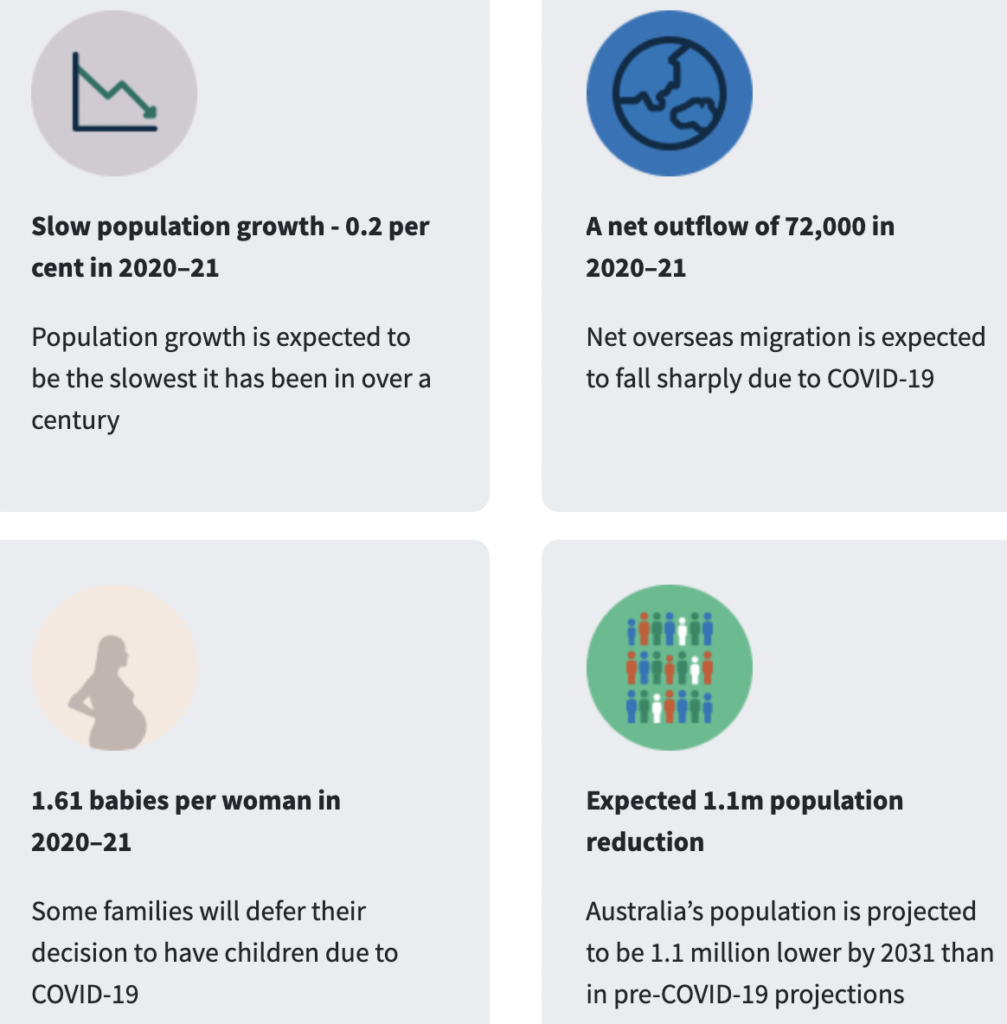
Australia’s population is projected to be 4 per cent smaller by 2030–31


Before the global pandemic hit the world Australia’s population was having a great run and growing at speeds that were never experienced before.


This growth made the government take measures like Infrastructure spending and different types of city planning in order to accommodate all the people that were either to come or to be born.


The Australian government centre for population decided to do a study and release their very first population statement. 


In this document you will find everything about how and where the population will grow. 


Some of the most interesting data and figures are around the time frame showing that Australia is now 3 years behind the original numbers.

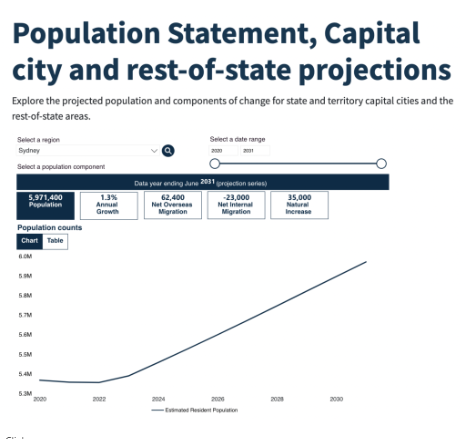
Before the pandemic Melbourne was supposed to take over Sydney population by 2026 when now the expectation is to reach by 2030–⁠31 with a population of 6.2 million, compared to 6.0 million in Sydney.


Capital cities are projected to bear the heaviest impacts, with total population across capital cities estimated to be around 5 per cent lower by 30 June 2031 than in the absence of COVID-19.


By contrast, population outside the capital cities is estimated to be around 2 per cent smaller than it would otherwise have been.

Australia’s population is estimated to be around 4 per cent smaller (1.1 million fewer people) by 30 June 2031 than it would have been in the absence of COVID-19.


The population will also be older as a result of reduced net overseas migration and fewer births. Despite COVID-19, Australia’s population is still growing and is expected to reach 28 million during 2028–⁠29, three years later than estimated in the absence of COVID-19.

Why is population observation so important when you talk about Property Investing?

Simple answer is you need people to live or buy the property from you in the future.


Complex answer is to try to be ahead of what will happen. If you are able to understand what could happen in the future before it happens than you don’t need to fight with others when everyone else is trying to buy.


Once the borders re-open and migration picks up again combined with an undersupply of new stock caused by COVID, that’s where the opportunity will arise!


Are you in the market and need help find your perfect property? Book a Free Chat.


share to

By Pina Brandi December 1, 2025
Melrose Park’s transformation from an industrial precinct into a residential and mixed-use community has been a strategically significant shift for Sydney’s urban future. Historically, the area was home to pharmaceutical and light-industrial operations, but over time these industries declined, consolidated elsewhere, or simply outgrew the outdated warehouses and fragmented road layout. Keeping the land zoned industrial would have meant under-utilising a large, strategically located pocket of Sydney at a time when housing demand is at critical levels. Redeveloping Melrose Park allows Sydney to introduce thousands of new homes in an inner-suburban area without pushing growth further to the city’s outskirts. With capacity for around 10,000–11,000 dwellings, plus retail, open space, a new high school and community facilities, the precinct is envisioned as a self-contained, modern neighbourhood with liveability at its core. Instead of being an isolated residential pocket, Melrose Park is being planned as a walkable, amenity-rich town centre where green spaces, urban parks, and mixed-use buildings form a cohesive and sustainable environment. Its location is one of its strongest advantages. Positioned on the Parramatta River, the suburb sits almost exactly halfway between Sydney CBD and Parramatta CBD, making it highly attractive for commuters who want balance, convenience and lifestyle. It is minutes from major employment hubs, established transport corridors like Victoria Road, and future connections that will further integrate the precinct into Sydney’s broader network. The land parcel is also unusually large and contiguous for an inner-suburban area, enabling a full masterplan rather than piecemeal development.  Overall, the shift from industrial to residential in Melrose Park wasn’t just a rezoning exercise; it was a strategic realignment of land use to meet Sydney’s changing economic, demographic, and lifestyle needs. Its prime location ensures the precinct will continue to attract demand, support growth, and deliver long-term value for residents and investors alike.
By Pina Brandi November 29, 2025
APRA has been explicit that the DTI cap is a financial‑stability tool, but it is deliberately designed not to choke off finance for new housing supply
By Pina Brandi November 25, 2025
If you’re searching for a property market that balances affordability, stability, and genuine long-term potential, Colac should be firmly on your radar. This regional hub positioned between Geelong, the Great Ocean Road, and the Western District s one of Victoria’s most economically diverse and quietly resilient cities. While many regional centres rely heavily on one dominant industry, Colac spreads its strength across manufacturing, agriculture, health care, tourism, and education. That diversity alone creates a foundation for steady employment, population growth, and a solid housing market three ingredients every smart investor looks for. With a median house price around $470,000 , a 0.5% vacancy rate , and a 49% increase in values over the last five years , Colac offers an impressive combination of affordability and upward momentum. Let’s break down why this unassuming regional city is becoming such a compelling place to invest or buy your first home. 
Show More